
Holding Two Generations: Caring Forward and Back
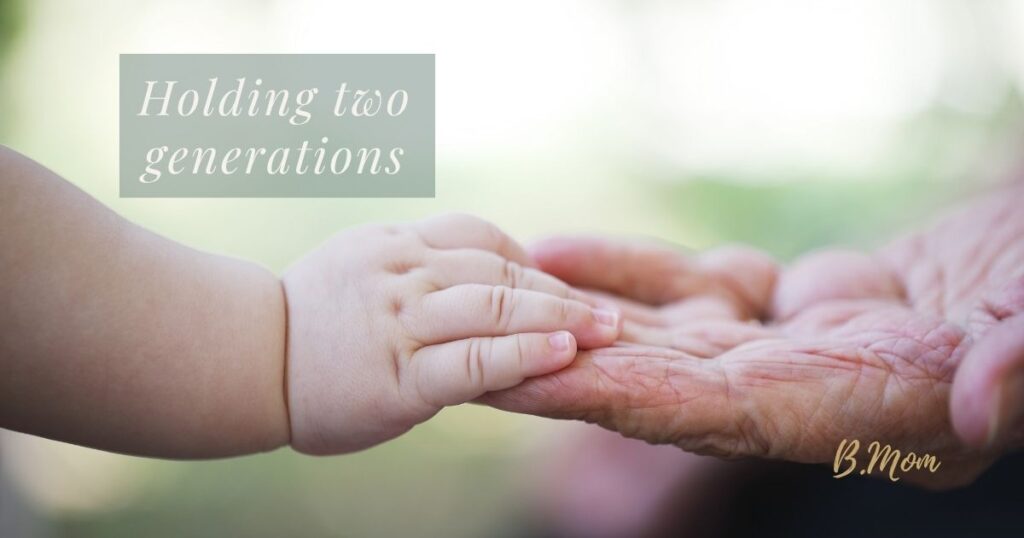
There is a season in motherhood that often arrives quietly.
It is not marked by a clear milestone. There may be no announcement, no formal change in role, no moment where someone says: this is where a new chapter begins. Instead, it often arrives through small realisations.
A parent needs more help than before.
A child still needs guidance.
A decision feels heavier.
A phone call carries more concern.
A medical appointment needs arranging.
A young person still needs hands on support.
And suddenly, a mother realises she is being needed in two directions.
She is still caring forward, towards her children.
But she is also beginning to hold backward, towards the generation before her.
This is what it means to hold two generations.
The mother in the middle
This season is sometimes called the sandwich years. But that phrase can sound almost too simple for what it actually feels like.
Because this is not only about being busy.
It is emotional.
Relational.
Historical.
Practical.
Tender.
Complicated.
A mother may still be supporting children, teenagers or young adults as they grow towards independence. At the same time, she may begin to notice that her own parents, or those who once held her, are becoming more vulnerable.
The direction of care begins to change.
With children, so much of motherhood is about helping them move outward. We teach, guide, support, encourage and slowly release. We help them become more capable, more independent, more able to live their own lives.
With ageing parents, the movement can feel different. A parent who once seemed strong may begin to need more patience, help, advocacy or care. The person who once made decisions for you may now need support with decisions of their own.
And the mother stands in the middle.
Looking forward.
Looking back.
Trying to remain steady for everyone.
The emotional stretch of divided care
There is a particular kind of tiredness that can come from being needed in both directions.
It is not only the physical tiredness of tasks, although those may be real. It is the emotional switching that can become exhausting.
One moment, you may be thinking about a child’s future.
The next, you may be thinking about a parent’s health.
One conversation may involve school, university, friendships or work.
The next may involve doctors, frailty, finances, family responsibilities or difficult decisions.
The mental load widens.
There are appointments to remember, messages to answer, decisions to make, feelings to hold and practical details that multiply quietly. The mother may become the person who notices, coordinates, follows up, checks in, reassures and organises.
And often, much of this remains invisible.
There is no job description for this stage. No clear boundary. No defined end point. Only the quiet sense that people need you, and that you are somehow supposed to keep holding it all.
When my father was dying
I experienced this season very personally when my children were still in primary school. My father became seriously ill, and for the year that followed, until his passing, I made a commitment to walk alongside him through each stage. It meant living in two worlds at once.
I was still mothering young children.
Still being a wife.
Still holding the ordinary responsibilities of home and family life.
And at the same time, I was supporting a parent whose needs were changing quickly.
The logistics were demanding. But the emotional weight was something else entirely.
There was the practical side: appointments, decisions, conversations, visits, arrangements and the quiet coordination that often happens behind the scenes. But beneath that, there was another layer — the tender and disorientating experience of watching someone who had once been strong become vulnerable.
At first, there was a temptation to keep these worlds separate.
Part of me wanted to protect my children from the reality of illness, suffering and loss. I wanted to shield them from what felt too painful. I wanted to keep their world as light and safe as possible. But over time, I realised that protecting them did not have to mean excluding them.
So I chose to bring them in, gently and in an age-appropriate way.
We spoke honestly.
We allowed visits.
We helped them understand what was happening without giving them more than they could hold.
We made space for questions.
We allowed sadness to exist alongside ordinary life.
It was not perfect, and it was not easy. But it was conscious.
In doing this, I did not shield them from life. I allowed them to witness it with support.
They saw care.
They saw vulnerability.
They saw what it means to show up for someone you love, even when it is difficult.
They saw that family life includes tenderness, sadness, presence and responsibility.
And in living through that painful season together, something meaningful was formed. It deepened our connection and gave us a shared understanding of love in action.
That experience changed something in me too. I began to understand that motherhood is not only about protecting children from pain. It is also about helping them move through life with honesty, steadiness and love.
We cannot keep our children from every difficult reality. But we can walk beside them. We can give them language. We can let them see that grief and love can exist together. We can show them that caring for family is not always easy, but it can be deeply meaningful.
In holding my father and my children at the same time, I began to see what mattered differently.
Not perfection.
Not control.
Not shielding everyone from discomfort.
But presence.
Communication.
Love.
The courage to stay connected in the middle of what is hard.
The grief inside the love
Holding two generations can bring deep love. It can also bring grief.
There may be grief in watching children need you differently. The child who once reached for your hand may now be reaching for their own life. They may be leaving home, becoming more private, making choices you cannot control, or needing you in less visible ways.
At the same time, there may be grief in watching a parent age.
Even when there is love, even when there is gratitude, even when they are still present, something shifts when the people who once held you begin to need holding themselves.
You may notice the slowing down.
The vulnerability.
The loss of certainty.
The changes in independence.
The reality that time is moving.
In one direction, you may be learning to let go.
In another, you may be gathering closer.
Both can be tender. And both can stir feelings that are difficult to name.
Love and sadness.
Duty and resistance.
Gratitude and frustration.
Tenderness and exhaustion.
Responsibility and resentment.
Care and grief.
These feelings can sit close together. And because mothers are often expected to be endlessly patient, endlessly available and quietly capable, many women judge themselves for the more difficult emotions.
But complicated feelings do not mean love is absent. They often mean the situation is complex.
What children learn when they witness care
One of the quiet gifts of this season is that children may witness care across generations.
They may see that family responsibility is not only spoken about, but lived. They may see tenderness, patience, practical support and ordinary acts of love. They may learn that ageing is part of life, not something to hide. They may see that dignity matters. That vulnerability deserves respect. That people need different kinds of care at different stages.
But they are also learning something else. They are watching whether care requires self-abandonment.
They are watching whether love means one person must carry everything. They are watching whether boundaries can exist alongside devotion. They are watching whether asking for help is allowed. They are watching how a family shares responsibility, speaks honestly and makes room for the humanity of the carer too.
This matters.
Because if a mother disappears completely into caring for everyone else, her children may learn that care means exhaustion, silence and self-erasure.
But if they see care that is loving, honest and supported, they learn something more sustainable.
They learn that love can have limits.
That responsibility can be shared.
That compassion does not require collapse.
That caring for others also means caring for the one who cares.
The mother in the middle has a life too
This may be the part mothers forget most easily.
The mother in the middle also has a life.
She has a body.
A marriage or partnership, perhaps.
Friendships.
Work.
Dreams.
Limits.
Health.
Grief.
Needs.
A self that still requires attention.
She is not only a bridge between generations. She is a person becoming too.
And perhaps that is why this theme belongs in Integration.
Because holding two generations gathers so many parts of motherhood at once: love and limits, memory and repair, responsibility and release, care and self-inclusion.
It asks a mother to look honestly at what she is carrying and to ask:
What is mine to hold?
What can be shared?
What needs support?
What must be accepted rather than controlled?
Where am I caring from love?
Where am I caring from guilt?
Where have I forgotten myself in the middle?
These are not easy questions. But they are important ones.
Because care is deepest when it is honest, shared and sustainable.
Holding forward and holding back
Motherhood does not happen in only one direction.
It stretches forward into the lives of our children. It stretches backward into the histories we come from. And sometimes, in the middle years, a mother finds herself holding both.
This stage can be tender and tiring. It can bring grief and gratitude close together. It can ask more than anyone sees. It can make a mother feel stretched, divided and unsure whether she is doing enough.
But perhaps integration begins when she stops asking herself to hold it all perfectly.
Perhaps it begins when she allows the truth to be complex.
I love them, and I need help.
I want to care, and I have limits.
I am responsible, but I am not responsible alone.
I am holding others, and I need to be held too.
Because the mother who holds two generations is not only carrying responsibility.
She is carrying history, love, memory, grief and becoming.
And she deserves support in the middle.